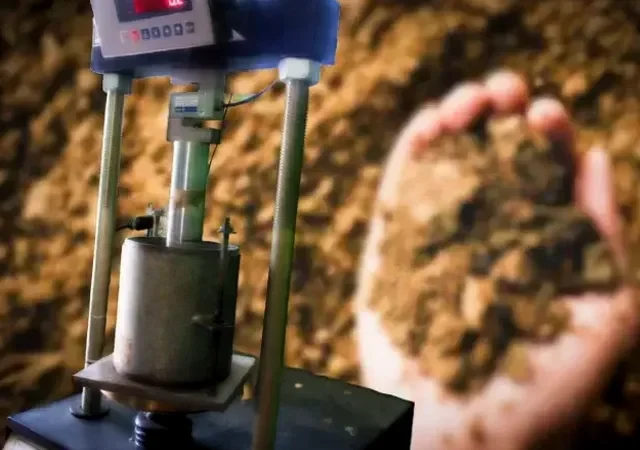
The blackland prairie clay in Frisco Texas turns pavement design into a puzzle. Summers bake the soil into a cracked, hard surface that looks stable. Then the spring rains come. The clay swells up tight. Water can't drain past a few inches. You dig a test pit and the bottom glistens with standing water within minutes. This is why a simple dry CBR value means nothing here. The only number that matters is the soaked CBR. We see it all the time in our lab. A sample arrives looking like solid rock. After four days submerged in water, it collapses to a mush that can't hold 3 percent CBR. That shift from dry strength to soaked mush is what destroys parking lots, residential streets, and warehouse floors across Frisco. Without a proper laboratory CBR test, your flexible pavement section is just a guess. And guessing in expansive clay gets expensive fast. We run the grain-size analysis alongside CBR to confirm the clay fraction driving the swell.
A soaked CBR of 2 percent in Frisco clay means your base course must bridge a material that behaves more like a fluid than a soil.
Quick answers
How much does a laboratory CBR test cost for a project in Frisco?
A single-point soaked CBR test with the standard Proctor compaction curve typically runs between US$120 and US$240 per specimen. A full three-point curve for pavement design generally requires three specimens. The exact cost depends on whether we need to run companion Atterberg limits or grain-size analysis on the same sample. We always recommend budgeting for the full three-point curve because the moisture-density-strength relationship is nonlinear in high-plasticity clays like those found across Frisco.
Why do Frisco clays require a soaked CBR test instead of a dry one?
The expansive clays of the Eagle Ford formation change dramatically with moisture. A dry sample can show a CBR above 20 percent, giving a false sense of security. The problem is that under a pavement, the soil reaches equilibrium moisture content closer to the plastic limit. Water gets trapped under the impermeable asphalt. The clay swells and loses bearing capacity. The soaked test simulates this worst-case scenario by submerging the specimen for four days. In our experience, the soaked CBR of Frisco clay is often less than one-quarter of the dry value. Designing with the dry number leads to under-designed pavements that rut and crack within the first two years.
How long does it take to get CBR results for a project in Frisco?
The laboratory process takes a minimum of five to seven working days from sample receipt. The soil must be dried, processed, and then compacted at the target moisture contents. The soaking period alone requires 96 hours. After soaking, we run the penetration test and produce the stress-penetration curve. If you need results for a fast-track project, we can often provide preliminary unsoaked values within 48 hours, but the soaked result remains the critical number for flexible pavement design in this region.