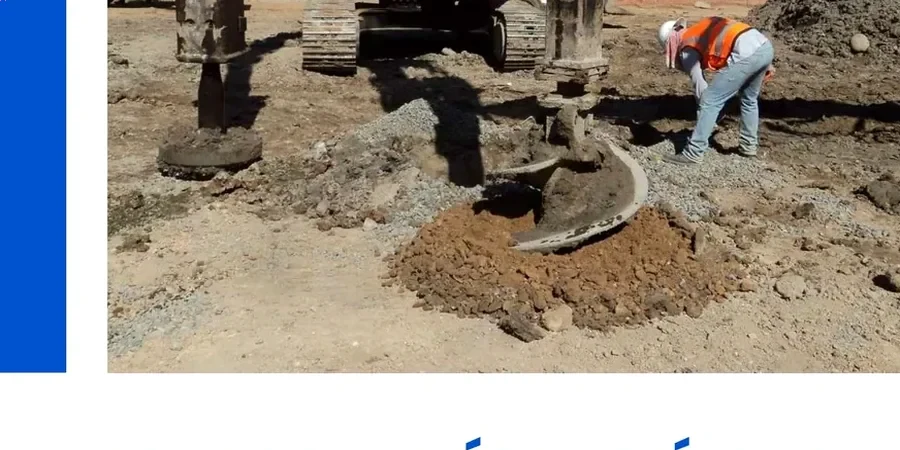
Frisco sits at roughly 774 feet above sea level on the northern edge of the Blackland Prairie, where Cretaceous-age Eagle Ford Shale weathers into notoriously active clay soils. With the city’s population surging past 230,000, new commercial pads and residential slabs increasingly encounter ground that swells when wet and shrinks dramatically during the summer droughts. A standard shallow footing in these conditions can experience differential movement exceeding two inches in a single season. Our stone column design work focuses on interrupting that expansive behavior by replacing portions of the problematic clay with compacted gravel columns, which act as vertical drains and stiffen the soil matrix. A reliable plate load test at column head level confirms the achieved modulus before structural loads are applied, giving engineers the verification required by the City of Frisco’s building officials.
A well-designed stone column grid in Frisco’s fat clays can cut post-construction settlement by half while providing a reliable drainage path for trapped pore water.
Our approach and scope
A recent project we reviewed involved a tilt-wall distribution center off the Dallas North Tollway extension, where the geotechnical report identified 18 feet of fat clay with PI values above 40. The structural engineer needed an allowable bearing pressure of 4,000 psf under isolated footings, but the untreated soil could only provide about 1,800 psf without excessive settlement. The stone column design incorporated a triangular grid at 6-foot spacing, with columns penetrating through the entire expansive zone and bearing on the underlying weathered shale. We specified clean crushed limestone with an aggregate size between 3/4 and 2 inches, compacted in lifts using a bottom-feed vibroflot monitored for amperage and penetration rate. Quality control included modulus tests at working load and a full-time geotechnical inspector logging the installation parameters. Beyond the bearing improvement, the columns function as vertical drains that accelerate consolidation of any saturated lenses trapped within the clay profile, a phenomenon we often encounter after the spring thunderstorm season in Collin County.
Quick answers
What does stone column design cost for a typical Frisco commercial lot?
Design fees for a stone column ground improvement package on a commercial site in Frisco generally range from US$1,610 to US$5,320, depending on the building footprint, number of borings to integrate, and whether 3D finite element modeling is required. The construction cost of the columns themselves is a separate line item driven by depth, grid density, and aggregate delivery logistics.
How deep should stone columns go in the Blackland Prairie clays?
In Frisco we typically extend columns through the full depth of the active zone, which based on local soil surveys and our boring data falls between 12 and 20 feet. Where soft, normally consolidated clay extends deeper, the column length is dictated by the stress bulb of the foundation, often reaching 25 to 30 feet to ensure adequate bearing on the Eagle Ford shale or a competent intermediate stratum.
Can stone columns eliminate the need for a suspended structural floor in expansive soil?
Stone columns significantly reduce heave potential by replacing expansive clay with inert aggregate and by accelerating drainage, but they do not completely isolate the slab from soil moisture fluctuations. For highly moisture-sensitive facilities we still recommend pairing the stone column grid with a void form system or a structurally suspended floor, depending on the plasticity index and the owner\'s tolerance for minor cosmetic cracking.