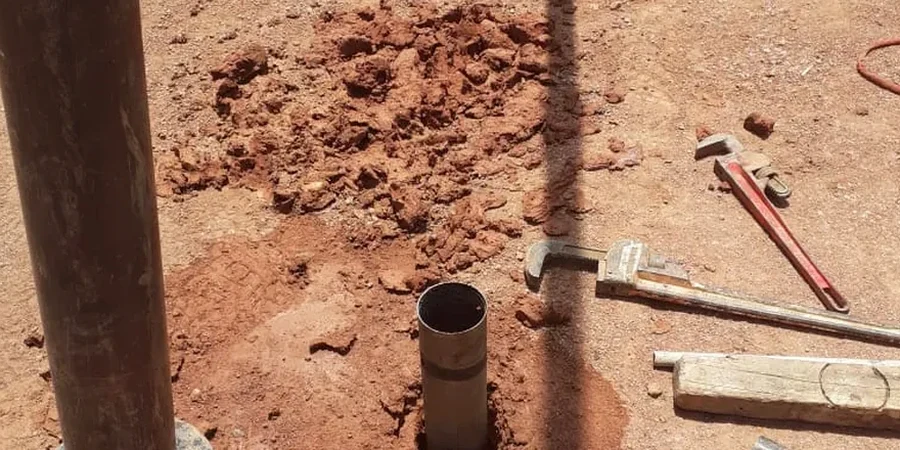
Frisco sits on the Eagle Ford Shale and Taylor Marl, formations that control how water moves—or doesn't—through the subsurface. With the city's explosive growth pushing development into areas with perched water tables and residual expansive clays, guessing the permeability is a gamble no engineer should take. The water table here can fluctuate several feet between the dry summer and the spring storm season, and a misjudgment in drainage design leads to pavement heave, basement leaks, or retention pond failures. Our field permeability testing program uses the Lefranc method for soil and the Lugeon method for rock to measure hydraulic conductivity directly in the borehole. We correlate these values with the grain size distribution and Atterberg limits from the same soil profile, giving you a complete picture of the formation's drainage behavior under actual field conditions.
A single Lugeon value of 25 in Frisco's shale can turn a dry excavation into a 500-gpm dewatering operation.
Our approach and scope
In the claystone and weathered shale common across Frisco, lab permeability tests on small samples rarely capture the influence of fissures, slickensides, and sand seams that dominate field behavior. We've seen sites near Stewart Creek where lab tests indicated a tight, low-permeability soil mass, but a Lugeon test in the underlying shale revealed water takes of 15-20 Lugeon units—and that changes the entire dewatering plan. Our team runs the constant-head or variable-head Lefranc test in soil, typically at 5-foot intervals within the zone of influence of the proposed footing, as outlined in ASTM D6391. For rock sections, the Lugeon test (following the Houlsby interpretation) applies pressure stages up to 10 bar, recording flow every minute until steady state. The data feed directly into seepage models, uplift calculations, and cut-off wall depth justification.
Regulatory framework
ASTM D6391-11: Standard Test Method for Field Measurement of Hydraulic Conductivity Using Borehole Infiltration, IBC 2021 Section 1803.5.3: Ground-water table investigation, USBR Design Standard No. 13: Embankment Dams, Chapter 8: Seepage Analysis and Control, FHWA NHI-06-089: Soils and Foundations Reference Manual, Volume II, Houlsby, A.C. (1976): Routine interpretation of the Lugeon water-test
Quick answers
What is the cost range for a field permeability test in Frisco, Texas?
A typical Lefranc or Lugeon test program in Frisco runs between US$560 and US$1,040 per test interval, depending on depth, access, and whether a drill rig is already on site. The cost includes packer setup, pressure stage execution, data reduction, and the permeability report. Mobilization and borehole drilling are priced separately.
When is a Lugeon test required instead of a Lefranc test?
A Lugeon test is the correct method when the formation is rock—specifically, when the Rock Quality Designation (RQD) is above 25% and a packer can isolate a test section. In Frisco, we apply it in the Eagle Ford Shale, Austin Chalk, and any limestone stringers. The Lefranc method is used in soil, residual clay, and highly weathered rock where a packer seal cannot be reliably achieved.
How long does a field permeability test take on site?
A single Lefranc test in soil typically takes 45 to 90 minutes once the test zone is prepared. A full five-stage Lugeon test in rock takes approximately 60 to 120 minutes per interval, depending on how quickly steady-state flow is reached at each pressure step. A typical two-interval program in one borehole can be completed in half a day.