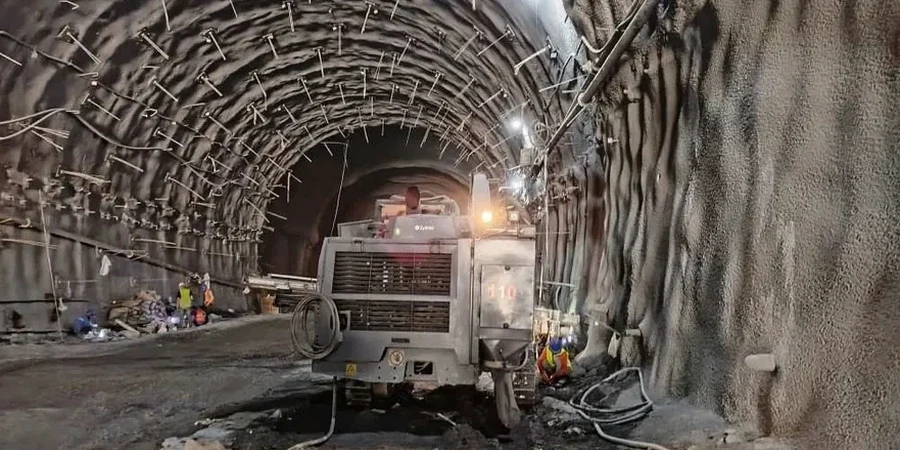
Contractors working east of the Dallas North Tollway in Frisco face a different subsurface than those near Lake Lewisville. The western sections sit on the Woodbine Formation—stiffer sandy soils that hold temporary cuts well. East of Preston Road, the Taylor Marl and Austin Chalk create a reactive environment where moisture fluctuations can shift an excavation wall by several inches in a week. The 33.16°N latitude puts the city in a zone where summer heat bakes the upper 6 ft to near-plastic consistency, then autumn rains saturate the same layer in 48 hours. Monitoring this isn't optional when you're 25 ft below grade with shoring towers adjacent to occupied buildings. The instrumentation program tracks lateral deformation, pore pressure buildup, and any movement at soldier pile anchors so the superintendent gets data before a condition becomes a claim. For deeper cuts where groundwater becomes a factor, the team often pairs monitoring with an in-situ permeability test to understand drainage behavior around the excavation perimeter.
In Frisco's Taylor Marl, a 0.3-inch lateral movement at the face can signal a 2-inch settlement at the adjacent footing within 72 hours.
Local geotechnical context
Collin County sits in Seismic Design Category A per IBC—ground shaking isn't the primary hazard here. The real risk is shrink-swell soil behavior. Frisco's expansive clay can exert swell pressures exceeding 5,000 psf, and when an excavation removes overburden at a corner lot, the retained soil mass relieves stress unevenly. A 2018 commercial dig near Stonebriar Centre recorded 1.8 in. of inward movement at the north wall over a single wet weekend; the shoring contractor had to install supplemental tiebacks before the structural slab pour could proceed. Without continuous monitoring, that movement would have gone undetected until formwork alignment failed. Another failure mode emerges when utility trenches intersect the excavation zone—water line breaks have occurred within 15 ft of monitored faces, saturating the clay and reducing passive resistance by 40% in under two hours. Real-time piezometer data gives the superintendent authority to pause work before a shoring collapse develops.
Quick answers
What does geotechnical excavation monitoring cost for a typical Frisco commercial project?
For a commercial excavation in Frisco with 3–4 monitoring sections and automated data collection, budgets typically range from US$800 to US$2,220 depending on instrumentation count, reporting frequency, and project duration. A standard 90-day program with inclinometers at 4 locations, 6 vibrating wire piezometers, and weekly survey reports falls toward the middle of that range. Projects requiring daily engineer-reviewed reports or extended post-backfill settlement monitoring run toward the upper end.
How often are monitoring readings taken during an active excavation in Frisco?
Readings depend on the excavation phase. During active digging and shoring installation, automated total stations collect data every 15 minutes, and an engineer reviews the daily cumulative report. Inclinometer baselines are read manually each morning before work begins. Once the excavation reaches final depth and shoring is complete, the frequency typically reduces to twice-weekly manual surveys with continuous automated piezometer logging. After backfill, settlement monitoring follows a 30-90-365 day schedule per the project specification.
Which IBC and OSHA requirements apply to excavation monitoring in Texas?
IBC Chapter 18 governs soils and foundation requirements, including provisions for excavation support and monitoring where adjacent structures are at risk. OSHA 29 CFR 1926 Subpart P mandates daily inspection of excavations by a competent person, and monitoring instrumentation provides the quantitative data that supports those inspections. For deep excavations near occupied buildings, the structural engineer of record typically specifies ASTM D6230-compliant inclinometer verification and settlement monitoring per ASTM D7299 as part of the shoring submittal package.