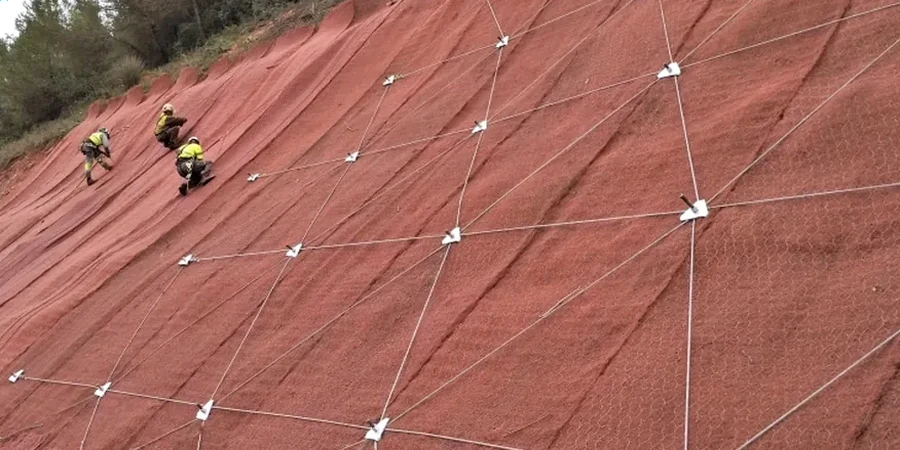
When we mobilize to a Frisco site, the first piece of equipment off the truck is usually our track-mounted drill rig paired with a digital inclinometer—critical tools for reading what's happening beneath those gently rolling slopes that define so much of Collin County. Most clients see grass and gentle grades; we see the subsurface puzzle of the Eagle Ford Shale and Taylor Marl formations that dominate this part of North Texas. A proper slope stability analysis starts with understanding how these weathered claystone layers behave under load, especially after the heavy spring rains that can saturate the upper 8 to 15 feet of overburden. We've worked sites from the Stonebriar area west to the PGA headquarters corridor, and the variability in shallow bedrock depth—sometimes 6 feet, sometimes 30—changes the entire stability model. Before we stake a single inclinometer casing, we often run a complementary CPT test to map continuous stratigraphy where the shale contact is erratic, giving us a baseline for the limit equilibrium analysis that follows.
A slope that stands today can fail tomorrow—not because the geometry changed, but because the pore pressure did. In Frisco's expansive clays, that is the rule, not the exception.
Our approach and scope
Frisco sits on the Blackland Prairie, where the surface geology is dominated by the Austin Chalk and Eagle Ford formations—highly plastic, overconsolidated clays that lose significant shear strength when moisture content climbs above the plastic limit. A typical residential cut in the Newman Village or The Trails subdivisions might stand at 1.5H:1V for years, then fail within 48 hours of a sustained rain event. That is why our analysis always incorporates both short-term (undrained, phi=0) and long-term (drained, effective stress) conditions per IBC Chapter 18 and ASCE 7-22 Section 11.8.3. We sample at multiple depths using thin-walled Shelby tubes, run consolidated-undrained triaxial tests with pore pressure measurement, and feed those parameters into Slide2 or SLOPE/W models. Where developers are cutting into weathered shale for a retaining wall or detention pond, we frequently pair the stability model with a
retaining wall design to ensure the global factor of safety exceeds 1.5 under seismic loading—Frisco is in Seismic Design Category A, but the expansive soil swell pressure can be just as destabilizing as any earthquake. For sites where the slope toe sits near a creek or drainage channel, a
seismic refraction survey helps us map the bedrock profile without disturbing the slope face.
Local geotechnical context
We have reviewed dozens of Frisco-area slope failures, and the pattern is almost always the same: a developer or grading contractor treats the native clay as a competent material without accounting for its moisture sensitivity. The cut gets excavated in August when the soil is dry and fissured, it stands fine through the fall, and then the March-April rains arrive. Water infiltrates those fissures, positive pore pressures build at the toe, and suddenly you have a rotational slump moving three feet overnight—taking out a fence line, a storm drain, or worse, threatening a foundation within the zone of influence. What makes this particularly frustrating is that the fix costs five to ten times more than the analysis would have. A slope stability analysis is not a regulatory checkbox; it is a construction-phase risk management tool that pays for itself the first time it prevents a collapse. In Frisco's specific geology, we also watch for the interface between the weathered mantle and the unweathered shale—that contact is a classic failure plane, and it demands a carefully calibrated strength reduction model to capture the progressive failure mechanism.
Regulatory framework
IBC 2021 Chapter 18 – Soils and Foundations, ASCE 7-22 Section 11.8.3 – Geotechnical Investigation Requirements, ASTM D1586 – Standard Penetration Test (SPT) and Split-Barrel Sampling, ASTM D4767 – Consolidated-Undrained Triaxial Compression Test, FHWA NHI-06-088 – Soils and Foundations Reference Manual Vol. I & II, ASTM D2487 – Unified Soil Classification System
Quick answers
How much does a slope stability analysis cost for a typical Frisco residential lot?
For a single-family residential slope—say a 10- to 15-foot cut in the back yard—the analysis typically runs between US$1,210 and US$3,990 depending on whether we need to drill a boring, run triaxial tests, or just model with existing geotechnical data from the subdivision. A simple desktop study using available soils reports falls at the lower end; a full investigation with lab testing and multiple cross-sections reaches the upper end.
Is slope stability analysis required by the City of Frisco for building permits?
The City of Frisco engineering department follows IBC 2021, which requires a geotechnical investigation including slope stability evaluation for any cut or fill exceeding 5 feet in height that could impact a structure or public right-of-way. Your civil engineer or permit coordinator will flag the requirement during plan review; we then provide the sealed report that satisfies the IBC Chapter 18 submittal requirements.
How long does a typical slope stability study take from start to finish?
A standard study for a Frisco site takes about two to three weeks. The first week covers drilling, sampling, and installing any instrumentation like piezometers or inclinometers. The second week is lab testing—triaxial and direct shear on the samples we pulled. The third week is modeling and report writing. If the site is large or the geology complex, add a week for additional cross-sections and peer review.
What is the difference between a global stability analysis and a surficial stability check?
Global stability looks at deep-seated failure surfaces that pass through the entire slope, often extending below the toe—these are the big, destructive slides. Surficial stability checks the upper few feet of the slope face for sloughing and shallow translational failures, which are extremely common in Frisco's expansive clays because the top 3 to 5 feet undergo seasonal wet-dry cycling that degrades shear strength. We evaluate both; one does not substitute for the other.