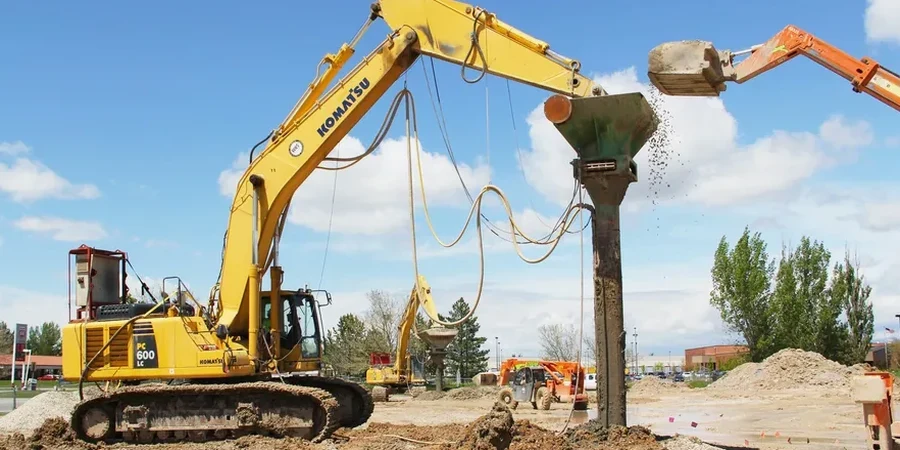
Frisco sits on the Blackland Prairie, where expansive clays and loose alluvial sands create a tricky foundation for any structure taller than a garden shed. With the city adding roughly 30,000 residents since 2020, the pressure to build on marginal plots has never been higher. Our vibrocompaction design work starts by mapping the depth to refusal and the fines content across the site, because skipping that step in Collin County means you’re guessing at densification radius. A well-tuned vibrocompaction plan turns silty sand with 15 percent fines into a bearing layer that can handle the column loads of a tilt-wall warehouse without over-excavation. We tie every design to CPT soundings and the site’s groundwater record, which in Frisco can sit just eight feet below grade during wet springs.
In Frisco’s layered prairie soils, vibrocompaction is as much about reading the clay seams as it is about the sand matrix—miss one and you’ve only densified half the column.
Quick answers
What does vibrocompaction design cost for a typical Frisco commercial lot?
For a standard commercial parcel in Frisco—say 2 to 6 acres—a complete vibrocompaction design package including desktop review, CPT correlation, test cell specification, and the stamped report typically runs between US$1,640 and US$5,670. The spread depends on how many borings we need to correlate and whether we’re designing for a single building pad or a phased development with variable fill thicknesses.
How do I know if my Frisco site is a candidate for vibrocompaction instead of over-excavation?
The quick filter is fines content. If your upper 20 feet has less than 15 to 20 percent passing the #200 sieve and the groundwater table is at least 5 to 6 feet below the working grade, vibrocompaction is usually viable. We confirm with a CPT sounding—the friction ratio and pore pressure data tell us whether the sand will densify efficiently or whether you’d be better off with a different ground improvement method.
What quality control do you require during vibro installation in Frisco?
We specify a pre-production test cell with at least three probe locations, monitored for amperage, penetration rate, and lift thickness. After the test cell, we run SPT or CPT soundings at the centroid and edge of the treated zone and compare the results to the target relative density in the design. The production phase gets the same monitoring parameters, and we spot-check every 5,000 square feet to keep the contractor honest.