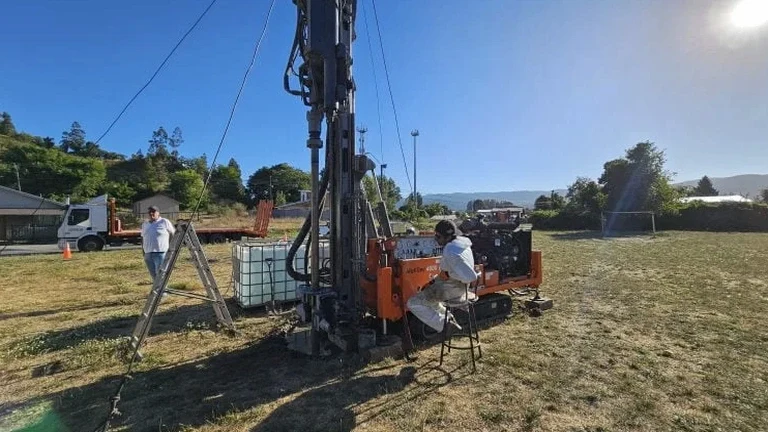
The subsurface contrast between Frisco's eastern Blackland Prairie clays and the western cross-timbers sandy loam is stark. Shallow foundations in the Phillips Creek Ranch area behave differently than those near the limestone outcrops west of the Dallas North Tollway. An exploratory test pit investigation maps this transition. The method provides direct visual inspection of stratigraphy, moisture content, and fill placement—data no borehole can replicate at the near-surface. For sites where shrink-swell potential governs slab design, the pit becomes the primary verification tool. We combine excavation with Atterberg limits testing to quantify plasticity indices that drive post-tensioned slab specifications across Collin County.
Direct visual logging of a 12-foot test pit profile eliminates the interpolation uncertainty inherent in spaced borings.
Quick answers
What does an exploratory test pit investigation cost in Frisco?
For a standard 10-foot depth pit with full logging, photography, and sampling in Frisco soils, the investigation typically ranges from US$560 to US$860 per pit. Variables include access constraints, shoring requirements if depth exceeds 12 feet, and whether groundwater monitoring extends beyond 24 hours. Sites requiring traffic control or HOA coordination may add mobilization charges.
How does an exploratory test pit differ from a standard soil boring?
A test pit exposes a continuous vertical face, allowing direct visual inspection of stratification, fissures, and slickensides that are invisible in disturbed boring cuttings. Block samples retain in-situ structure and moisture. Borings provide depth capacity beyond 15 feet and undisturbed thin-wall tube samples; pits excel at near-surface verification and fill documentation.
Does the City of Frisco accept test pit logs for foundation permits?
Yes. The City accepts test pit data as part of the geotechnical report submitted under IBC Chapter 18. The log must include soil classification per ASTM D2487, groundwater observations, and the responsible engineer's seal. For post-tensioned slab designs, we supplement pit data with laboratory plasticity and swell testing.
How long does a test pit remain open for inspection?
We schedule the pit so the logged profile is accessible for client or structural engineer inspection during daylight hours on the excavation day. By day's end, we backfill in compacted lifts. Extended multi-day observation applies only when groundwater inflow monitoring is specified. Safety barricades remain in place until final closure.