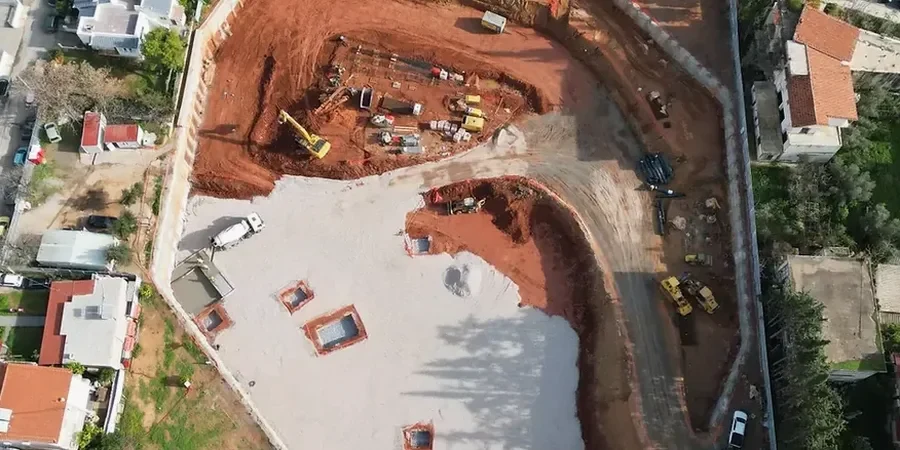
Frisco sits on the Blackland Prairie, where the Eagle Ford Shale weathers into highly plastic, expansive clays with swelling potentials that routinely catch out-of-town contractors off guard. We see projects along the Dallas North Tollway corridor where a 20-foot cut can behave like a 40-foot cut if the moisture profile isn't mapped correctly during the exploration phase. The difference between a well-executed excavation and a costly delay often comes down to how thoroughly the pre-construction soil sampling and SPT drilling program captures the seasonal saturation boundary, because the undrained shear strength in these fat clays can drop by half between August and February. Our geotechnical team integrates laboratory Atterberg limits with field CPT data to build a subsurface model that accounts for the desiccation cracks and perched water tables so common in this part of Collin County. This isn't textbook excavation design — it's applied soil mechanics calibrated to the actual behavior of Frisco's formations, where smectite content drives both the earth pressure envelope and the required tieback preload.
In Frisco's expansive fat clays, the earth pressure diagram isn't a textbook triangle — it's a trapezoid shaped by seasonal moisture migration and desiccation cracking.
Local geotechnical context
The North Texas climate cycles between prolonged summer drought and intense spring cloudbursts, and this oscillation is the primary driver of excavation risk in Frisco. When a fat clay cut face absorbs moisture from a May thunderstorm after six weeks of desiccation, the lateral swell pressure can add 15 to 25 pcf of equivalent fluid pressure that wasn't in the original design assumptions — a mechanism that has unzipped more than one soldier pile wall along the US-380 corridor. We've learned to specify a sacrificial facing layer of shotcrete within 24 hours of cut exposure, even when the permanent wall isn't scheduled for weeks, because the time-dependent strength loss in Eagle Ford shale is exponential, not linear. The other variable that keeps project managers awake is the interaction between adjacent excavations; Frisco's block-by-block development pattern means a new basement often sits 30 feet from an existing parking garage, and the stress relief from dewatering on one side can tilt a neighboring mat foundation if the retaining wall system isn't designed with a stiffness threshold that limits angular distortion to less than 1/500.
Regulatory framework
IBC 2021 – Chapter 18 (Soils and Foundations) and Chapter 33 (Safeguards During Construction), ASCE/SEI 7-22 – Section 12.13 (Earth Retaining Structures) and Chapter 19 (Soil-Structure Interaction), ASTM D1586 – Standard Test Method for Standard Penetration Test (SPT) and Split-Barrel Sampling, ASTM D2487 – Standard Practice for Classification of Soils for Engineering Purposes (Unified Soil Classification System), FHWA Geotechnical Engineering Circular No. 4 – Ground Anchors and Anchored Systems, OSHA 29 CFR Part 1926 Subpart P – Excavations (Trenching and Shoring requirements)
Quick answers
What is the typical cost range for a geotechnical design of a deep excavation in Frisco?
The fee for a complete deep excavation design package in Frisco typically falls between US$1,960 and US$7,180, depending on the cut depth, shoring system complexity, and the number of tieback levels required. A straightforward single-level soldier pile wall for a 20-foot basement will be at the lower end, while a multi-level anchored secant pile system with groundwater cutoff, finite element modeling, and a full instrumentation plan will approach the upper range. The scope always includes the geotechnical interpretive report, lateral earth pressure calculations, structural sizing of the shoring elements, and the construction sequence drawings; any additional specialty testing such as pressuremeter or cross-hole sonic logging is quoted separately.
How do Frisco's expansive clays affect the lateral earth pressure on the shoring wall?
Frisco's Blackland Prairie clays contain smectite minerals that expand significantly when they absorb water, and this swelling generates a lateral pressure component that conventional Rankine or Coulomb theory does not capture. We measure the swell pressure directly through constant-volume oedometer tests and then superimpose it onto the drained earth pressure envelope over the zone of seasonal moisture fluctuation — typically the upper 12 to 15 feet. In practice, this means the apparent earth pressure diagram for a Frisco excavation often requires a trapezoidal distribution near the top of the wall, with a higher equivalent fluid pressure than what the standard IBC table would suggest for a stiff clay, and this directly influences the soldier pile spacing and the preload specified for the upper tieback row.
What groundwater challenges should I expect during a deep excavation in Collin County?
Most Frisco sites encounter a perched water table within the weathered shale zone at depths between 10 and 20 feet, which is sustained by infiltration through desiccation cracks and doesn't always appear on a regional groundwater map. Below that, the contact between the Taylor Marl and the underlying Woodbine Formation can act as a confined aquifer with artesian pressures that require a deliberate dewatering strategy — simply sumping from the excavation bottom can trigger piping and loss of passive resistance at the toe. Our design approach includes transient seepage modeling with wellpoints or deep wells positioned outside the excavation footprint, and we specify the drawdown rate to avoid rapid changes in effective stress that could cause consolidation settlement under adjacent shallow foundations.