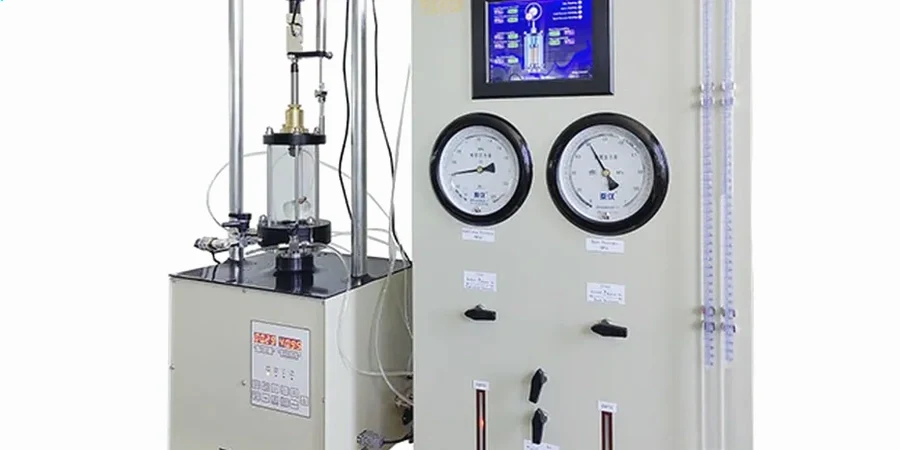
A 14-story mixed-use tower going up near the Dallas North Tollway in Frisco had us running consolidated-undrained triaxial tests on stiff clay samples from 40 feet down. The developer needed to confirm the shear strength parameters before finalizing a mat foundation design that would save them $300,000 compared to the original deep pile scheme. In the expansive, high-plasticity clays that dominate the Eagle Ford formation beneath Frisco, getting the effective stress parameters wrong is not an option. We see this scenario repeatedly as the city pushes past 250,000 residents and vertical construction intensifies around The Star and Frisco Station. The triaxial test remains the most reliable laboratory method for determining the drained and undrained shear strength of foundation soils, and when paired with field exploration like SPT drilling, it provides the complete subsurface picture that structural engineers need for safe, cost-optimized designs.
Effective stress parameters from a properly run triaxial test can reduce foundation costs by 15 to 25 percent compared to conservative assumptions from index tests alone.
Local geotechnical context
Chapter 18 of the International Building Code (IBC 2021), as adopted by the City of Frisco, mandates that foundation designs for structures exceeding two stories be supported by adequate geotechnical investigation. For deep foundations, footings on slopes, or any structure classified as Risk Category III or IV, the code effectively requires shear strength parameters derived from laboratory testing rather than empirical correlations. The stiff, fissured clays of the Eagle Ford Group present a particular challenge: their behavior transitions from brittle peak strength at low strains to fully softened residual strength along pre-existing slickensides, a condition that can reduce the operational shear strength by up to 60 percent. Relying solely on pocket penetrometer readings or standard penetration test blow counts without triaxial verification exposes the project to either unconservative design or excessive overconservatism. We have observed this directly on excavations along Legacy Drive where apparently competent clay lost significant strength upon stress relief and wetting. The triaxial test is not a commodity procedure; it requires careful specimen preparation and interpretation by engineers who understand the local stress history of the North Texas Cretaceous sediments.
Regulatory framework
ASTM D4767-11 (2020) – Standard Test Method for Consolidated Undrained Triaxial Compression Test for Cohesive Soils, ASTM D2850-23 – Standard Test Method for Unconsolidated-Undrained Triaxial Compression Test on Cohesive Soils, ASTM D7181-20 – Standard Test Method for Consolidated Drained Triaxial Compression Test for Soils, AASHTO T-297-22 – Standard Method of Test for Consolidated, Undrained Triaxial Compression Test on Cohesive Soils, IBC 2021 Chapter 18 – Soils and Foundations
Quick answers
How much does a triaxial test program cost for a typical Frisco commercial project?
A standard three-specimen CU triaxial suite on a single Shelby tube sample typically ranges from US$1,710 to US$2,770, depending on confining pressures, required strain rates, and whether we include p-q stress path plotting and stiffness modulus interpretation. Most Frisco projects require two to four suites to characterize the key strata. We provide a fixed-price proposal after reviewing the boring logs and project structural requirements so there are no surprises.
What soil types in the Frisco area benefit most from triaxial testing?
The high-plasticity, overconsolidated clays of the Eagle Ford Group are the prime candidates. These soils exhibit significant strength anisotropy and can lose substantial shear resistance upon wetting or unloading. Triaxial testing captures the effective stress behavior that index tests like Atterberg limits cannot quantify. We also recommend triaxial testing for the residual soils overlying the Austin Chalk, where the presence of calcareous cementation creates complex drained behavior not captured by simpler shear tests.
How long does it take to get triaxial test results?
A CU triaxial suite typically requires 10 to 14 business days from sample receipt to final report. The consolidation phase alone can take 24 to 72 hours per specimen depending on clay permeability, and the shearing stage is run at strain rates as slow as 0.002 in/min. We can expedite UU testing to 5 to 7 business days when construction schedules demand faster turnaround, and we always communicate expected timelines before starting the program.
Do you provide the stress path plots and stiffness parameters for finite element modeling?
Yes. Every CU and CD triaxial report includes deviator stress vs. axial strain curves, excess pore pressure vs. strain plots, Mohr-Coulomb failure envelopes for both total and effective stress, Cambridge p-q stress paths, and secant Young's modulus at 50 percent of peak deviator stress. If your structural engineer requires hyperbolic model parameters or small-strain stiffness from local instrumentation, we can configure the test accordingly.