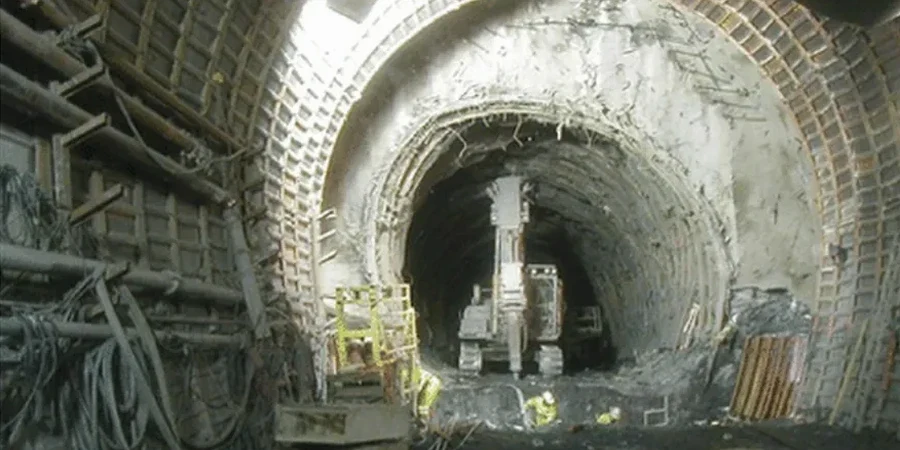
In Frisco many times we see projects where the alignment crosses old creek beds that don't even show on surface maps anymore. The upper 20 to 30 feet here is mostly stiff to very stiff clay from the Austin Chalk formation, but the real challenge for a soft soil tunnel is what lies beneath: pockets of saturated silty sand left by the Elm Fork tributaries that wandered across this area over centuries. A standard boring alone won't catch these transitions. That's why our geotechnical analysis for soft soil tunnels pairs continuous sampling with piezometer data, letting the design team see where the face might ravel before the TBM ever arrives. We've run these investigations from Panther Creek Parkway down toward Stonebriar, and the variability never fails to surprise. For deeper characterization in mixed ground we often combine the field program with CPT testing to pick up thin sand seams that Shelby tubes miss.
Frisco's soft clay can hold a 15-foot face open for weeks, but hit a sand lens and the same heading can collapse in hours if the groundwater isn't controlled.
Quick answers
What's the typical cost range for a geotechnical analysis of a soft soil tunnel alignment in Frisco?
The investigation budget depends heavily on the alignment length and the number of boreholes required, but for a typical municipal utility tunnel or short trenchless crossing in Frisco the field and lab program generally falls between US$3,710 and US$15,950. Longer drives with multiple access shafts and instrumentation arrays will run higher.
Which ASTM tests matter most for soft clay tunnel design?
We prioritize undrained triaxial compression (ASTM D4767) for strength envelopes, one-dimensional consolidation for settlement estimates, and Atterberg limits (ASTM D4318) to confirm material behavior across the alignment. Grain size per ASTM D422 helps identify transitions into silty or sandy facies.
How do you handle groundwater when the tunnel alignment runs below the water table across Frisco?
We install multi-level vibrating wire piezometers during the investigation phase and monitor seasonal fluctuation for at least one wet season before finalizing face support pressures. If perched zones are detected we map their extent with CPT soundings and recommend dewatering or face conditioning.
Can the same investigation support both an EPB shield and a sequential excavation method?
Yes, but the lab program gets broader: EPB design requires soil conditioning tests and abrasion indices, while SEM needs stand-up time estimates and detailed stress-strain curves. We generate a unified data set that both the TBM supplier and the contractor's temporary works designer can work from.