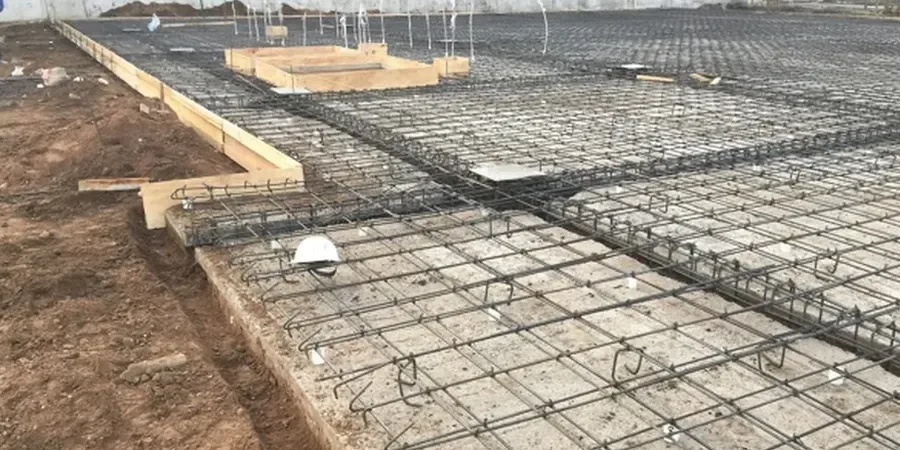
Frisco’s population exploded from under 40,000 to over 200,000 in two decades, transforming former farmland into dense subdivisions and commercial corridors. That growth pushed construction onto the Eagle Ford Shale and Taylor Marl, formations notorious across Collin County for high plasticity clays. When you place a structure on these soils, differential heave becomes a real structural threat. A mat foundation distributes building loads across a large continuous slab, reducing bearing pressure and resisting seasonal ground movement. Our team has worked on projects from Stonebriar Centre to the PGA headquarters area, where the geotechnical profile often shows active zones extending down 10 to 14 feet. We combine local drilling data with advanced structural modeling to design foundation systems that won't crack when the clay swells after a wet spring. For sites with deeper unsuitable layers, we evaluate if stone columns can improve the upper strata before mat construction begins.
On Frisco's expansive clay, a well-designed mat foundation doesn't just support the structure — it acts as a rigid diaphragm that bridges soft spots and resists differential heave.
Our approach and scope
Design follows ASCE 7-22 and the IBC 2021 edition, with soil parameters derived from ASTM D1586 SPT borings and ASTM D2487 classification. In Frisco, we typically see clay with liquid limits above 45 and plasticity indices exceeding 25, which puts it squarely in the CH category. The mat thickness ranges from 18 to 36 inches depending on column loads and the soil's allowable bearing capacity, which we often verify through
plate load tests on the prepared subgrade. We model the slab as a beam on elastic springs, assigning spring constants from the site-specific modulus of subgrade reaction. Ribbed mats work well for residential slabs subject to edge heave; flat mats with pedestals suit commercial steel frames. Every design accounts for the 1,500 to 2,000 psf allowable bearing pressures typical of compacted select fill over native clay. The reinforcement detailing follows ACI 318-19, with top and bottom mats sized for both positive and negative bending moments induced by center lift and edge drop conditions. When tower cranes or heavy equipment loads govern, we integrate
footings beneath column lines for localized load transfer within the overall mat geometry.
Local geotechnical context
In Frisco, we often see builders place a 4-inch slab-on-grade without a geotechnical investigation, and within three years the drywall cracks show up. The culprit is almost always differential heave on the perimeter of the slab, where moisture variation is greatest. A mat foundation mitigates this, but only if the design incorporates the actual depth of the active zone determined by soil suction profiles. Skipping that step means the ribs or beams may not extend deep enough to anchor into stable moisture content. We also find that poor drainage around the finished slab concentrates water at one corner, triggering localized heave that even a well-reinforced mat struggles to handle. Construction sequencing matters too: placing the mat on desiccated clay without pre-wetting can lead to long-term heave as the soil slowly rehydrates under the impermeable floor. The fix is a combination of moisture-conditioned subgrade, vapor barrier, and perimeter drainage that keeps the foundation environment as stable as possible.
Quick answers
How much does a mat foundation design package cost for a Frisco residential project?
Residential mat foundation design in Frisco typically ranges from US$1,080 to US$4,820 depending on the home's footprint, number of stories, and whether post-tensioning is included. The package covers soil investigation, structural calculations, and signed, sealed drawings ready for city permit submission.
What makes Frisco soils so hard on conventional slab foundations?
The Eagle Ford Shale and Taylor Marl formations under Frisco contain clay minerals that expand significantly when wet and shrink when dry. With active zone depths reaching 10 to 14 feet, a thin slab-on-grade cannot resist the differential movement, leading to cracking and structural distress over time.
Do I need a mat foundation or will a post-tensioned slab be enough?
For single-family homes on Frisco's expansive clays, a properly designed post-tensioned slab often performs well. Mat foundations become necessary when column loads are high, the structure exceeds two stories, or the geotechnical report indicates highly variable soil conditions across the site.
How long does the design and approval process take?
A typical mat foundation design package for a Frisco project follows this timeline: geotechnical investigation takes 2-3 weeks including lab testing, structural design and modeling require 2-3 weeks, and city plan review adds 2-4 weeks depending on the current workload at the Development Services department.